
| PAYWALL REMOVED |
| This is a collaborative article. Vaasa Insider independently decides on and creates the editorial content, while partner companies sponsor free access to the article. Together, we support Ostrobothnian business. |
The green transition is changing both industries and careers, making new skills and adaptability increasingly important. During Green Skills Week in Vaasa, students, educators and companies come together to discuss how to prepare for the future.
Eva Bligt-Lindén opened Green Skills Week 2026 in the Vaasa City Council Chamber. Vaasa has been awarded the European Commission’s European Green Leaf Award this year, recognising the work already done in the city and region and the path ahead towards carbon neutrality.
“This year is significant. It is an opportunity to show the whole world what we can bring to the table,” Bligt-Lindén said.
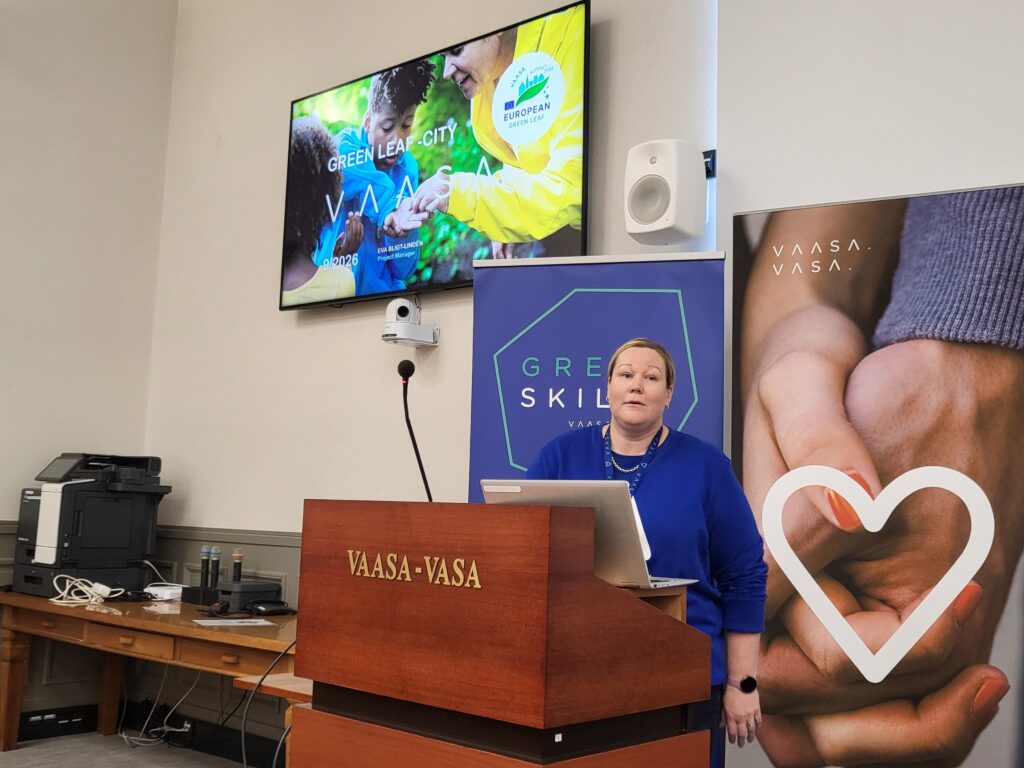
She highlighted the strong cooperation between companies, public authorities and educational institutions in the Vaasa region.
“Many of the companies here are exporting, so the whole world benefits from the innovations developed in this region.”
An ecosystem for green skills
Green Skills Vaasa is built around cooperation between education and working life. The network grew out of an EU project and now brings together Vamia, Novia University of Applied Sciences, the University of Vaasa, Vaasa University of Applied Sciences (VAMK), Yrkesakademin i Österbotten (YA), VASEK and Merinova.
Josefin Stolpe, coordinator of the Green Skills Vaasa network at VASEK, describes it as an ecosystem where different organisations can learn from each other.
Green Skills Week is one of the activities organised through the network. Stolpe encourages companies interested in cooperation, including possible participation in future events, to get in touch.
“Through this ecosystem, we can influence education so that it becomes even better aligned with the needs of companies,” she said.
Career paths are changing
MPS Jonathan Rasmus challenged the traditional idea that young people should know what they want to become.
The world of work is changing rapidly, he argued, and organisations need people who are able to adapt to changing circumstances.
“New technologies are destroying some jobs, while creating and changing others,” Rasmus said.
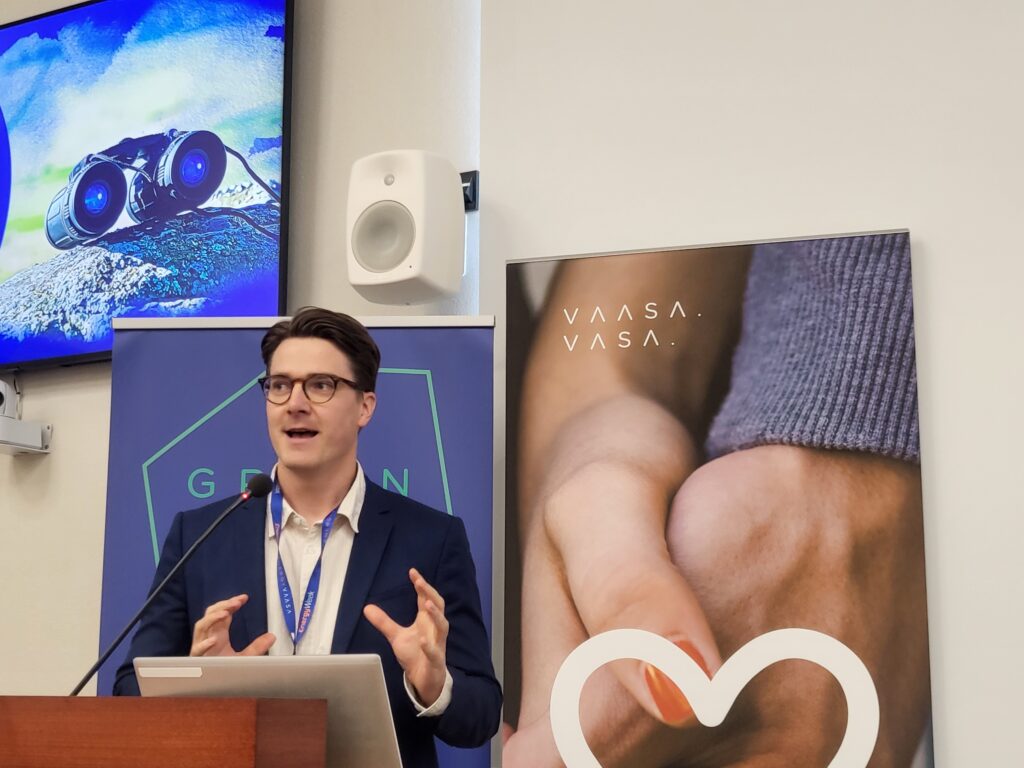
He pointed to the IT sector as an example. Before the pandemic, coding was widely presented as a secure career choice. Today, the situation looks different.
“For more and more young people, traditional career paths simply do not exist.”
Instead of trying to predict one specific career, Rasmus encouraged the students to think about their own “north star” and what they want to get out of life.
Is it money? And if so, how much? Is it work-life balance? Or is it making a contribution to the world?
Rasmus also noted that green skills are increasingly relevant to employers.
Building smarter, not simply cheaper
Marcus Jansson, CEO of Ingenjörsbyrå Kronqvist, brought the discussion into the construction industry. For Jansson, the green transition is about development, persistence and a willingness to keep improving.
One challenge in Finland is that construction is often driven by the lowest possible price. Choosing cheaper materials may, however, result in higher costs and a greater environmental impact over the long term.
“We cannot stop building, but we must start building smarter,” Jansson said.
That means considering not only the construction itself, but also the energy use of buildings throughout their entire life cycle.
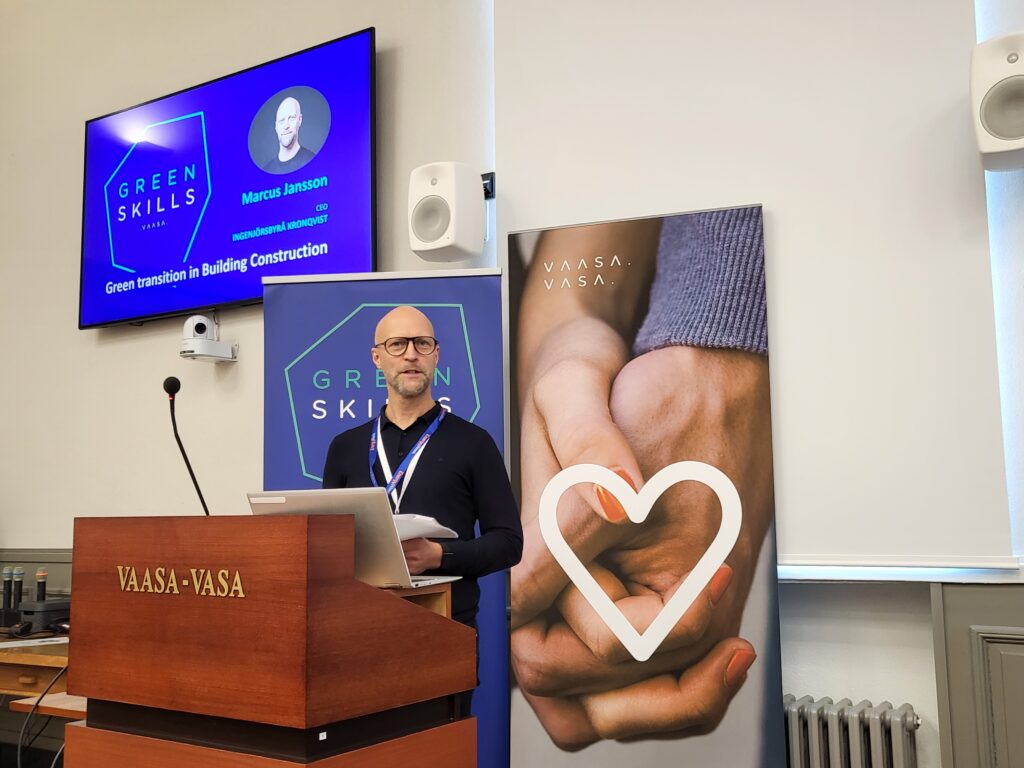
He also argued for a stronger focus on circularity. Materials should be selected and used with the idea that they will eventually be reused rather than becoming waste.
At the same time, sustainability must make economic sense.
“We need to balance profitability and sustainability.”
ABB tackles sustainability both locally and globally
ABB’s Johanna Keturi and Sanna-Mari Kaakinen presented the company’s approach to sustainability.
ABB develops energy-efficient products that help customers advance the energy transition. At the same time, the company is working to improve the energy efficiency of its own production facilities in Vaasa.
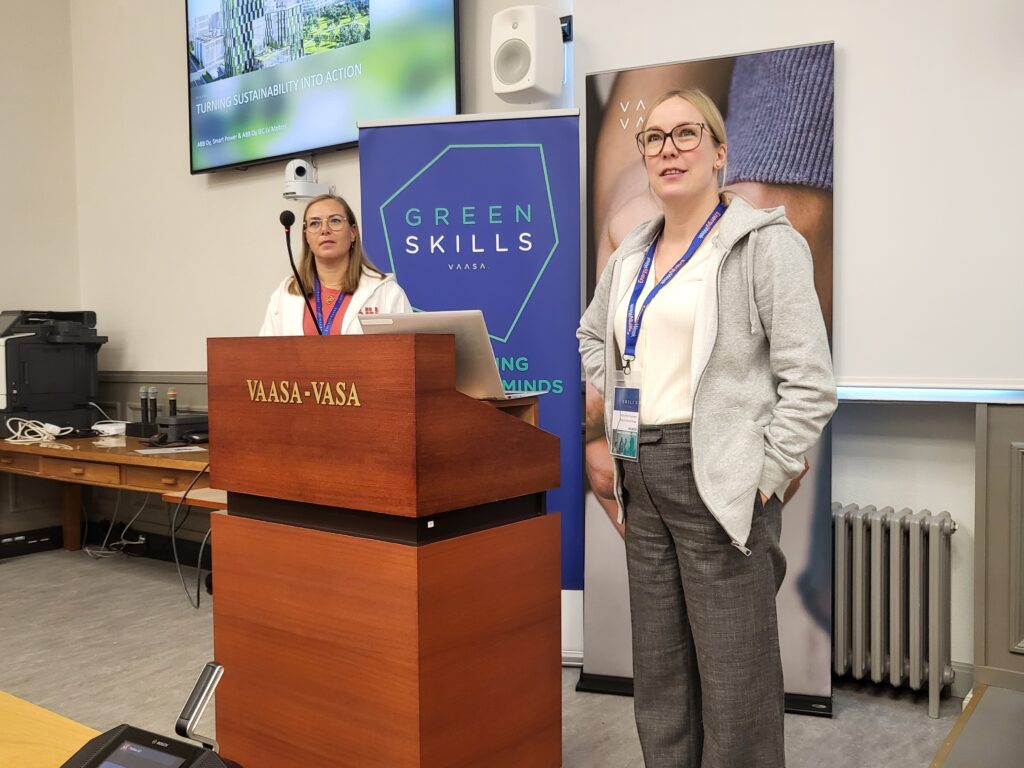
With facilities around the world, ABB develops local solutions to local challenges while at the same time delivering solutions to global problems. In Vaasa, at Strömberg Park, this includes measures related to automation, ventilation, lighting and heating systems.
The skills employers need
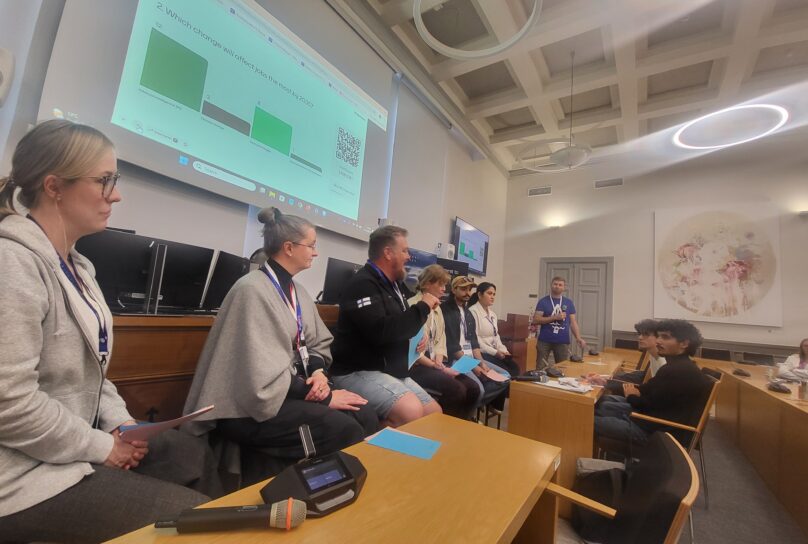
The day ended with a panel discussion involving industry representatives, teachers and students.
Sari Järvenpää, People Leader, Mechanics Engineering at Danfoss, emphasised the importance of attitude and willingness to learn.
“A great attitude will take you far.”
A great attitude will take you far.
She also highlighted a skill that is becoming increasingly important as artificial intelligence develops.
“AI can give you answers, but you also need the ability to validate whether the data is realistic or not.”
Adaptability, critical thinking and the ability to keep learning are important parts of the modern workplace.
Students have their say
The students on the panel were asked which skills they would like more opportunities to develop.
“I would like to grow my skill of adaptability,” said Isha Devkota, an Energy Technology student at VAMK.
Trent Aliphon, an Automotive student at Vamia, had a shorter answer:
“Public speaking.”
His answer, delivered with a twinkle in his eye, brought laughter from the audience.
Many open doors throughout the week
Green Skills Week is one part of a busy week focused on sustainability. The national Sustainability Week is taking place, with a wide range of events organised across the region.
For example On Tuesday, Yrkesakademin i Österbotten organised a day focusing on the circular economy. On Wednesday, September 23, Vamia will open its doors for Future Mobility. Companies, experts, students and teachers will gather to explore and demonstrate green solutions in traffic, construction and land use.
Katarina Sandbacka, Vamia’s Manager of International Affairs, says that cars are increasingly resembling computers on wheels, while electrification is accelerating the transformation of the sector.
“This is a huge transition for everyone working in this field.”
On Thursday, September 24, green technology will be in focus at both Alere and Technobothnia. The week will also include a networking event at Vaasa Hacklab at Kasarmi 37 on Saturday.
More information on the different events and how to particapte can be found here.
READ ALSO:
Norcar gears up with CNH Construction – Nykarleby-based company targets continued growth